Key Takeaways:
- Trim is used around floors, walls, ceilings, doors, windows, corners, and transitions.
- Common trim types include baseboard, crown molding, casing, chair rail, picture frame molding, wainscoting, shoe molding, quarter round, and floor transition trim.
- Trim and molding are closely related, but trim is usually the broader term. Molding often refers to shaped or decorative profiles.
- The right trim depends on location, function, material, profile, room scale, and installation conditions.
- A good trim plan should feel coordinated across the home, but every room does not need the exact same trim profile.
Types of trim often become important when a room looks almost finished, but still feels incomplete. The walls are painted, the flooring is installed, and the doors and windows are in place, yet the edges may still look plain or exposed.
Trim helps finish these details. It frames openings, softens transitions, protects lower walls, and gives the room a more complete look.
This guide explains the main types of trim, common terms, and how to choose the right option.
What Is Trim in a House?
Trim is the finishing material used to complete edges, openings, joints, and transitions in a house.
You usually see trim at the bottom of walls, around windows and doors, near ceilings, on feature walls, and around exterior openings. Without trim, many joints between wall, floor, door frame, window frame, and ceiling would look unfinished.
A simple example is baseboard trim. It covers the joint where the wall meets the floor and gives the room a cleaner lower edge. In the same way, door casing frames a door opening, while crown molding finishes the line between the wall and ceiling.
That is why types of trim should be understood by both location and purpose.
Trim vs Molding vs Casing vs Millwork
Molding and trim are often used together, but they are not exactly the same.
The table below explains the common differences between trim, molding, casing, and millwork.
Trim is the broad category. Molding is often a shaped or decorative type of trim. Casing is trim used around doors and windows. Millwork is a broader production term that can include trim, molding, panels, and other interior woodwork.
For professional woodwork projects, standards such as the Architectural Woodwork Institute’s millwork and wood trim guidance can be useful references when details, tolerances, and finish expectations need to be defined.
Main Types of Trim by Location
The easiest way to understand the main types of trim is by location. A trim piece near the floor has a different job from trim around a window, and ceiling trim is not the same as wall molding.
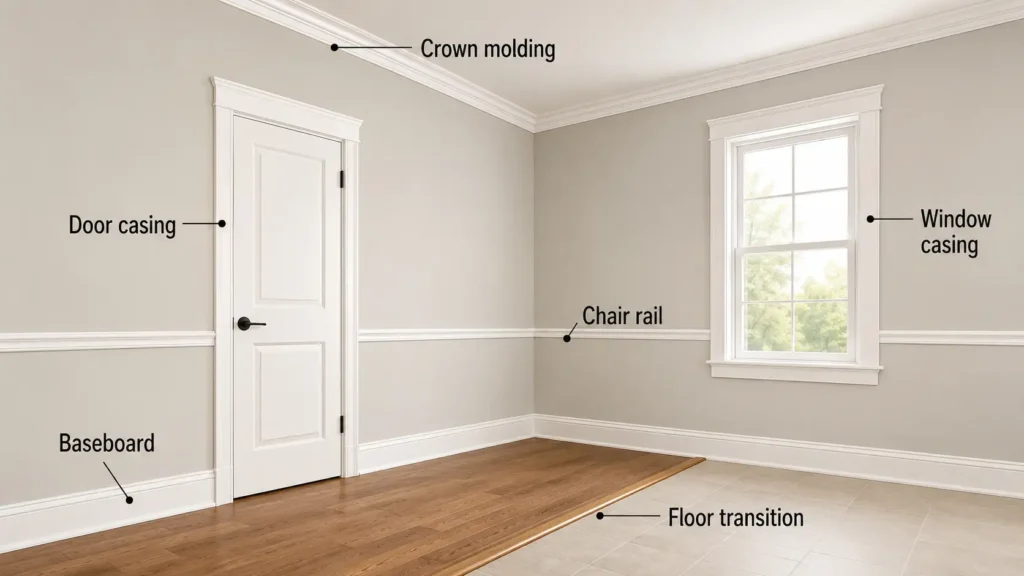
Quick Overview of Common Trim Types
The table below gives a quick overview of where common trim types are used and what each one does.
Floor and Base Trim Types
Floor and base trim are among the most common trim details in homes.
Baseboard, also called base molding or skirting in some markets, runs along the bottom of the wall. It gives the room a finished edge and protects the wall base from daily wear. For a closer comparison of terminology, materials, sizes and retrofit options, see what a skirting board is and how to choose one.
Shoe molding is a smaller trim piece used where the baseboard meets the floor. It is useful when flooring movement, uneven walls, or installation tolerances leave small gaps.
Quarter round moulding is similar, but it has a fuller rounded profile. It is often used along floors, cabinets, and base transitions.
Floor transition trim is employed where two flooring materials meet, such as wood to tile, laminate to carpet, or floor to threshold.
When I compare floor trim options, I usually start with the floor material, wall condition, and finish style. A clean modern space may only need simple baseboard. A more traditional room may use taller base molding or a more detailed profile. For project-based options, compare Lyngou’s wood baseboard trim profiles, including flat, rounded, grooved, and traditional designs.
Ceiling Trim and Crown Molding
Ceiling trim is used near the joint between the wall and ceiling.
Crown molding is the most recognized type of ceiling trim. It creates a more finished transition at the top of the wall and is often used in living rooms, dining rooms, bedrooms, and formal interiors.
But crown molding is not the only ceiling trim. Cove molding uses a softer curved profile and can create a simpler transition. Other ceiling trim may be flat, stepped, or built up from several pieces.
A common question is whether crown molding is a type of trim. Yes, it is. Crown molding is one type of ceiling trim, while ceiling trim is the broader category.
Wall Trim and Decorative Molding
Wall trim is for the wall surface, not just around the edge of a room.
Chair rail is usually installed at mid-wall height. It protects walls and divides the wall into upper and lower sections.
Picture rail sits higher on the wall and was traditionally used to hang artwork without damaging the wall surface.
Picture frame molding creates decorative rectangular or square frames on a wall. It is common in classic, transitional, and modern luxury interiors.
Wainscoting and board and batten are more complete wall trim systems. They can add texture, protect lower walls, and create stronger architectural character.
Door and Window Trim Types
Casing often refers to door and window trim.
Door casing frames the door opening and covers the gap between the door frame and the wall finish.
Window casing frames the window and helps it connect with the surrounding wall surface.
Door and window casing should work with the baseboard. They do not need to be identical, but the thickness, profile, and finish should feel coordinated.
For example, a very thin casing paired with a tall, heavy baseboard may feel unbalanced. If both use a simple square-edge profile, the room feels cleaner and more modern.
Interior vs Exterior Trim
Interior trim and exterior trim serve different purposes.
The interior trim is mainly about proportion, finish quality, room style, and clean transitions between floors, walls, ceilings, doors, and windows.
Exterior trim has to deal with weather, moisture, sealing, and long-term durability. Exterior window trim and exterior door trim should look good, but they also need to protect vulnerable openings and support proper drainage.
Trim Pieces and Accessories People Often Miss
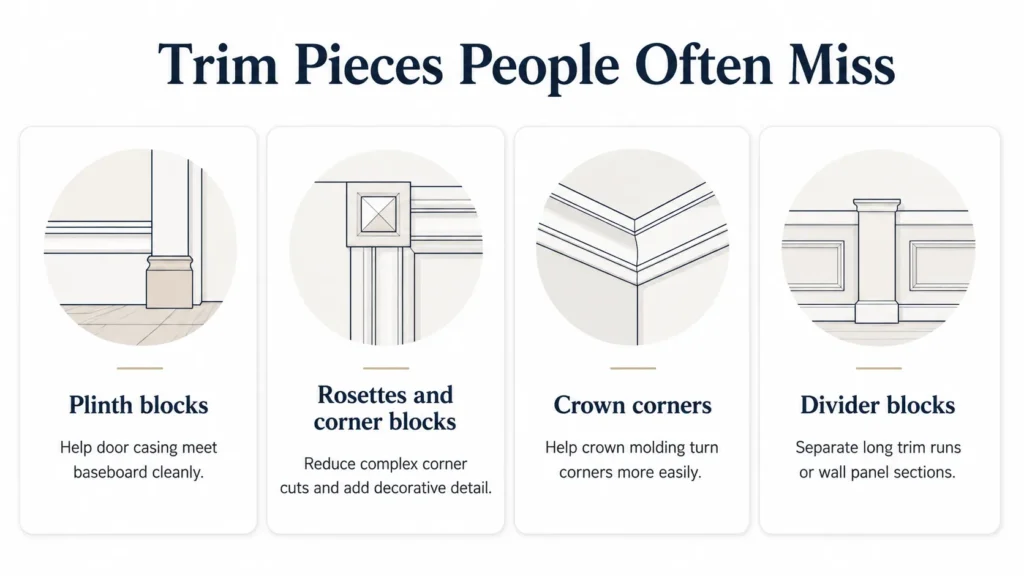
Many people focus on the main types of trim, but small accessory pieces can decide whether the final detail looks clean.
Plinth Blocks
A plinth block is a thicker block installed at the bottom of door casing. It helps the door trim meet the baseboard cleanly, especially when the baseboard is taller or thicker than the casing.
Rosettes and Corner Blocks
Rosettes and corner blocks are decorative blocks used at the corners of door or window casing.
They reduce the need for precise miter cuts and create a more traditional or craftsman-style detail.
Crown Corners
Crown corners come into use where crown molding changes direction. They make installation easier in rooms with many corners.
Divider and Intermediate Blocks
Divider blocks can separate long trim runs, frame wall panel sections, or help different trim pieces meet with a clean transition.
These pieces are easy to overlook, but they are useful in built-up trim designs and repeated project supply.
Trim Profiles, Sizes, and Styles
After location, the next decision is profile, size, and style.
Two pieces of trim can serve the same purpose but create very different results. A flat stock baseboard looks modern. A colonial profile feels more traditional. A tall baseboard gives the wall a stronger base. A small rounded trim brings a softer finish.
Common Trim Profiles
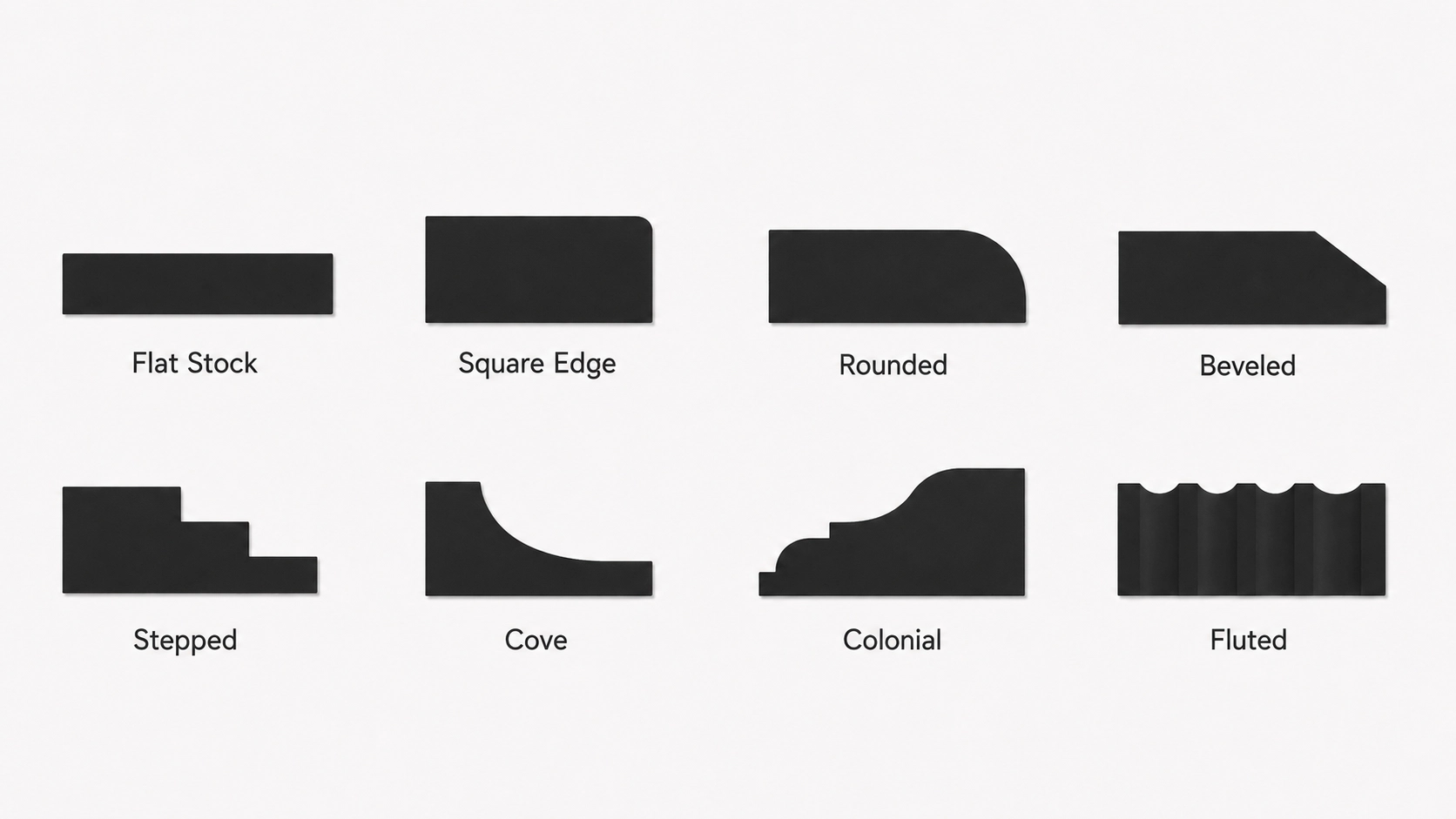
Common trim profiles include:
- Flat stock
- Square edge
- Rounded profile
- Beveled profile
- Stepped profile
- Cove profile
- Colonial profile
- Fluted profile
Simple profiles are easier to match across rooms. For simple flat-stock trim, S4S lumber provides smooth faces and consistent edges that can reduce preparation before cutting and installation.
More decorative profiles can add character, but they also need better coordination with doors, cabinets, flooring, and wall details.
Single-Piece Trim vs Built-Up Trim
Single-piece trim uses one board or molding profile. It is simpler to specify, easier to install, and often works well in modern or budget-sensitive projects.
Built-up trim combines several boards or molding pieces to create a wider, deeper, or more custom look. For example, a baseboard may be combined with a base cap and shoe molding. A window casing may use flat boards, a header, and decorative blocks.
Built-up trim looks more refined but requires careful planning. Thickness, reveal lines, corner details, and installation sequence all matter.
How to Choose Trim Size and Proportion
Trim size should match the scale of the room.
A small room with a low ceiling may look better with simple, lighter trim. A larger room or taller ceiling can handle wider baseboards, stronger casing, or crown molding.
The goal is not to choose the largest profile. The goal is to make the room feel balanced.
A rule I use is this: trim should support the room, not compete with it.
Modern, Craftsman, Traditional, and Contemporary Trim Styles
Modern trim often uses flat stock, clean lines, square edges, and painted finishes.
Craftsman trim often uses wider boards, simple geometry, layered casing, and stronger proportions.
Traditional trim may use crown molding, chair rail, picture frame molding, taller baseboards, and more detailed profiles.
Contemporary trim sits between modern and traditional. It may use clean lines with warmer materials or slightly softer profiles.
When choosing a trim style, start with the room instead of the catalog. Look at the ceiling height, door style, flooring, wall color, and how much detail the space can handle.
Trim Materials at a Glance
Material choice affects cost, appearance, durability, painting, staining, and long-term performance.
The table below compares common trim materials by best use and main limitation.
For wood trim, moisture and dimensional stability should be considered early, especially when the material will be stained, exposed, or used in changing humidity conditions.
Paint-grade trim is chosen when the final surface will be painted. Smoothness, consistency, and clean joints matter more than visible grain.
Stain-grade trim is chosen when the wood grain will remain visible. Species, grain pattern, color, and surface quality become more important.
When a project needs more than standard profiles, Lyngou offers highly customized wood trim and molding options, including baseboards, casing, decorative trim, material selection, profile adjustment, and project-based production support.
How to Choose Trim Without Overcomplicating It
Choosing trim is easier when you start with the room instead of the catalog. First, decide which edges, openings, or transitions need to be finished. Then narrow the choice by profile size, material, finish, and how visible you want the trim to be.
Use simple profiles when the trim should feel clean and quiet. Choose more detailed or built-up trim when the room needs stronger architectural character. In high-use or moisture-prone areas, durability and sealing should come before decoration.
For hospitality, multi-unit, or other commercial projects, consistency matters. Confirm profile drawings, dimensions, material, finish, packing, labeling, and installation responsibility before production. This helps avoid mismatched trim pieces later.
Before You Choose or Order Trim
Before choosing or ordering trim, confirm the location, profile, material, finish, linear footage, corner details, and whether the trim will be painted or stained.
Also allow extra material for cutting waste, mistakes, damaged pieces, and future replacement. Simple rectangular rooms usually need less extra material than houses with many corners, angled walls, stairs, or built-up trim details.
Simple baseboard, flat stock casing, shoe molding, and basic floor transition trim are usually easier to install. Crown molding, wainscoting, built-up trim, exterior trim, and premium wood finishes usually require more careful measuring and installation planning.
When trim forms part of a wider prefab or interior package, review it together with the other building components rather than ordering each item in isolation.
FAQs About Types of Trim
What are the main types of trim?
The main types of trim include baseboard, shoe molding, quarter round, crown molding, cove molding, chair rail, picture rail, picture frame molding, wainscoting, board and batten, door casing, window casing, corner molding, and exterior trim.
What is the difference between trim and molding?
Trim is the broader term. It refers to finish pieces used around edges, openings, and transitions. Molding usually refers to shaped or decorative trim profiles, such as crown molding or picture frame molding.
Is it molding or moulding?
Both are correct. Molding is the common American English spelling, while moulding is more common in British English. In most trim and millwork contexts, they mean the same thing: a shaped or decorative trim profile.
What is floor trim called?
Floor trim may be called baseboard, base molding, skirting board, shoe molding, quarter round, or floor transition trim, depending on where it is used and what it needs to cover.
What is ceiling trim called?
Ceiling trim may be called crown molding, cove molding, cornice molding, or ceiling molding. Crown molding is one of the most common types of ceiling trim.
What is the difference between shoe molding and quarter round?
Shoe molding is usually slimmer and less rounded. Quarter round has a fuller rounded shape. Both are commonly used to cover small gaps between the floor and baseboard.
Should trim be the same throughout the house?
Trim should feel coordinated throughout the house, but it does not need to be identical in every room. You can vary height, profile, or detail level as long as the material, color, proportion, and style feel consistent.
Conclusion
Trim is a small detail with a strong visual impact. It helps a room feel finished, balanced, and intentional.
The best choice is not always the most decorative trim. It is the trim that fits the room, material, style, and installation needs.
Understanding the main types of trim makes it easier to choose the right detail for each project.