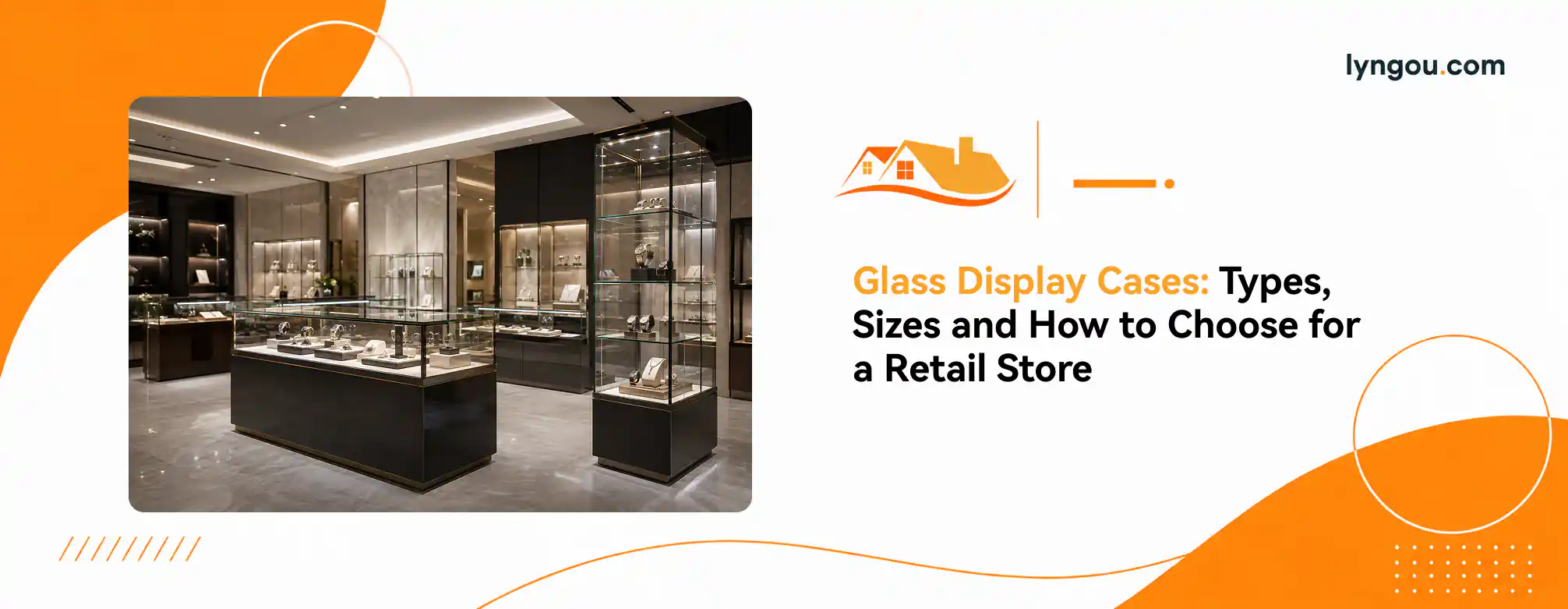
Glass display cases should do more than place merchandise behind glass. The right case improves visibility, controls access, supports staff workflow and fits naturally into the way customers move through the store.
If you are opening a store or replacing existing fixtures, the choices can become confusing quickly. Full vision or half vision? Countertop or floor-standing? Sliding doors or hinged doors? Tempered glass? Adjustable shelves? LED lighting? Standard size or custom?
I would start with four questions: What are you displaying? Where will the case sit? Who needs access to it? How should customers interact with the merchandise?
Once those points are clear, the right fixture format becomes much easier to identify.
Key Takeaways:
- Choose the case around the merchandise, viewing height, security needs and staff workflow, not appearance alone.
- Countertop, full-vision, floor-standing, tower, wall and corner cases address different merchandising and space-planning needs.
- Glass type, doors, locks, shelving and lighting should reflect how the fixture will actually function day to day.
- Size the case together with surrounding circulation and delivery access, not as an isolated cabinet.
- When several cases form one counter, matching dimensions and connections becomes part of the fixture design.
Types of Glass Display Cases for Retail Stores
There is no single best glass showcase. A jewelry store, electronics shop, and cosmetics boutique may all use glass display cases, but they require different balances of visibility, storage, security, and access.
Full Vision, Half Vision and Extra Vision Display Cases
These terms are common in commercial retail fixtures, but suppliers do not always use them in exactly the same way. It is safer to compare the actual glass area, storage configuration and dimensions rather than rely on the category name alone.
For maximum visibility, a full vision showcase keeps most of the customer-facing area transparent, allowing the merchandise to remain the visual focus.
When storage matters just as much as presentation, a half vision display case is often the better compromise. The solid lower section can hold packaging, supplies, or backstock while the upper glass area handles the display.
An extra vision display case often increases the glass viewing area while keeping a smaller solid base.
In simple terms, full vision prioritizes presentation, half vision balances display with lower storage, and extra vision usually provides a larger visible product area.
Countertop Glass Display Cases
A glass countertop display case suits merchandise that benefits from close viewing without requiring a large freestanding cabinet.
A jewelry display case often follows this format because small, valuable items need controlled access and a comfortable viewing height. The same reasoning applies to watches, electronics accessories, and premium collectibles. For very small products, a compact glass display box can provide close viewing and controlled presentation without requiring a full countertop cabinet.
What matters here is positioning. Customers should be able to inspect the merchandise naturally, while staff should be able to retrieve it without excessive bending or reaching.
Glass Counter Cases With Sliding Doors
A glass counter case with sliding doors is particularly practical behind staffed counters.
Rear sliding doors avoid the swing clearance required by hinged doors and keep product access on the employee side. In a narrow service zone, that can make daily operation noticeably smoother.
The real questions are whether the doors move cleanly, lock where needed, give staff access to the full interior, and remain easy to clean.
Corner Glass Display Cases
Corner cases connect adjoining counters in L- or U-shaped layouts, avoiding an unused gap where two straight runs meet.
The corner unit should match the adjoining cases in height, depth, finish and glass configuration so the full counter looks continuous.
Floor-Standing Glass Display Cabinets
Floor-standing display cabinets provide greater vertical capacity than countertop cases and are a good fit for cosmetics, accessories, gifts and collectibles.
A large glass display case only adds value when the extra volume remains easy to browse. Excessive depth or too many shelves can reduce visibility if products sit too far back or too low.
With a tall glass display case, the strongest viewing zones should be reserved for merchandise that deserves the most attention.
Tower Glass Display Cases
A tower glass display case uses vertical space efficiently while keeping the footprint relatively small.
It suits compact stores and features merchandise such as premium accessories, limited editions, or collectibles. Choose a tower when visibility and product focus matter more than maximum storage capacity.
Wall-Mounted and Wall-Positioned Glass Display Cases
A glass wall display case keeps merchandise along the perimeter, leaving more central floor space open for circulation or other fixtures.
A smaller glass wall display box can highlight selected premium products. For wall-mounted cases, check the wall structure and fixing method before production.
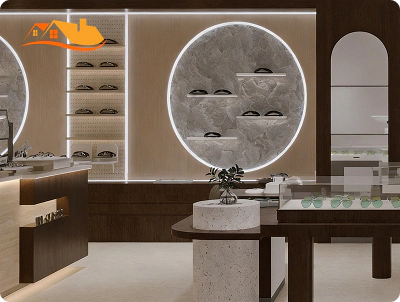
Glass Display Tables
A glass display table creates a different browsing experience because customers can approach it from several sides.
It works well in central merchandising zones, showrooms and premium retail environments where the fixture itself becomes a focal point.
The main consideration is circulation. A display table should attract attention without narrowing the path around it or creating congestion when several customers stop to browse.
Access and Security of Glass Display Cases
After choosing the basic case type, the next question is: who needs to open it, and how often?
That usually determines the most suitable door and locking arrangement.
Sliding Doors vs. Hinged Doors
Sliding doors are a strong choice when staff work in a narrow zone or retrieve products frequently. Hinged doors can provide wider access to the cabinet interior, but they need swing clearance.
The decision should follow daily workflow. A door that looks cleaner in a rendering may still be the wrong option if it blocks the staff aisle every time it opens.
When Do You Need a Locking Glass Display Case?
A locking glass display case makes sense when merchandise value or theft risk calls for controlled access.
For higher-value goods, the lock should be considered together with the access side, door alignment and normal staff routine. Security should protect the product without making customer service unnecessarily slow.
Cleaning and Dust Control
Glass reduces direct handling, but a display case is not automatically dustproof.
Door gaps, sliding tracks and cable openings should be planned so the interior remains easy to clean and maintain.
Glass, Shelving and Display Configuration
Once access has been resolved, the next decisions shape how the merchandise looks and how flexible the fixture will be in daily use.
Tempered Glass Display Cases
A tempered glass display case is common in retail environments because tempered glass is stronger than ordinary annealed glass and breaks into smaller pieces when it fails.
However, tempered glass is not unbreakable, and not every glass panel in every retail display case is automatically required by law to be tempered.
For U.S. projects, federal safety glazing rules apply to specific architectural glazing uses, such as certain doors and wall panels. They should not be treated as a blanket rule for every retail showcase.
For an actual project, the glass specification should clearly define the glass type, thickness, panel size, edge treatment, and shelf load. This is more reliable than using a vague phrase such as “safety glass.”
Framed or Frameless?
With glass front display cases, the frame profile can noticeably affect sightlines and the overall visual weight of the fixture.
A frameless showcase creates cleaner sightlines and can suit minimalist retail environments.
A framed case gives the structure more visual definition and may integrate more naturally with metal detailing, finished bases or adjoining counters.
Neither option is automatically more premium. The stronger choice is the one that fits the store design and the way the fixture needs to be built.
Fixed or Adjustable Glass Shelves?
A display case with glass shelves benefits from adjustable shelf positions when product heights change or seasonal merchandising requires greater flexibility.
The point is the adjustment range, shelf load, number of positions and whether the arrangement leaves enough practical clearance for the actual products.
A deeper shelf may increase theoretical capacity, but it can also make merchandise at the rear harder to see and reach. In retail, usable display space matters more than maximum internal volume.
LED Lighting: When Is It Worth Adding?
A glass counter display case with LED lights can strengthen the presentation of jewelry, watches, cosmetics and other detail-rich merchandise.
The lighting still needs to be designed around the product.
Poor placement can create glare, reflections, dark areas below shelves, or visible wiring. Top lighting may suit an open display zone, while shelf-level or vertical lighting can provide more even coverage in taller cabinets.
For custom cases, LED channels, drivers and cable routes are best planned before production rather than added afterwards.
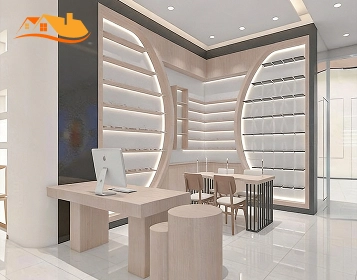
Back Panels, Mirrors and Finishes
The back of the case has a direct effect on how merchandise is perceived.
A glass back maintains visibility from more than one direction. A solid back creates stronger visual separation and can carry a coordinated color or finish. A mirror back adds reflected views of small products, although it can become visually busy in a densely stocked cabinet.
The frame, base, and back panel should be planned as one material system, not chosen as separate details.
How to Choose the Right Size for Your Glass Display Cases
There is no universal correct display-case size.
Commercial suppliers often offer modular lengths such as 4 ft and 6 ft, but these are common product formats rather than rules for every retail store.
A more reliable method is to size the fixture from the merchandise outward.
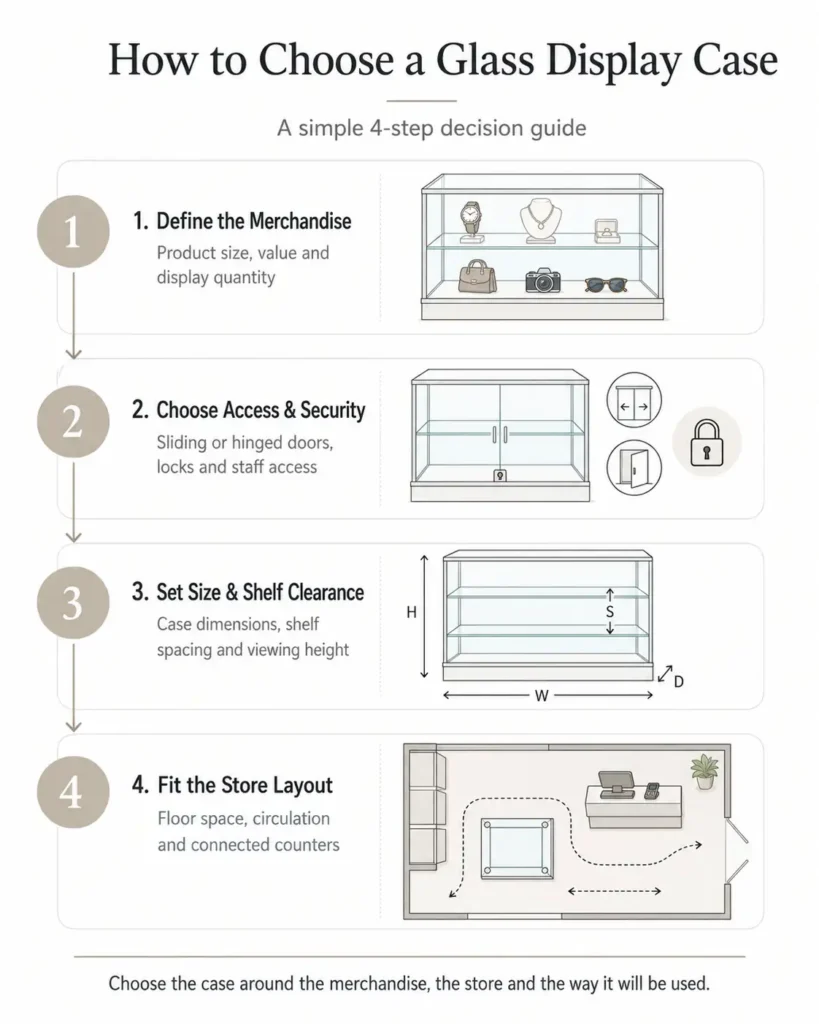
1. Start With the Merchandise
Measure the largest realistic product and include packaging dimensions if boxed goods will also be displayed.
The case needs enough internal room for the product itself, visual separation, and practical handling. Something that technically fits into the opening can still be awkward to remove or poorly presented.
2. Set the Viewing Height
Important merchandise should sit where customers can inspect it comfortably.
Counter displays naturally place products closer to standing eye and hand level. Tall cabinets need more deliberate product placement because the highest and lowest shelves usually receive less attention.
Reserve the strongest viewing zones for the merchandise that deserves the most focus.
3. Check Width and Depth
Extra width increases capacity but also lengthens the fixture.
Extra depth accommodates larger products but can move merchandise farther from both customers and staff.
With a large glass display case, bigger dimensions only improve the result when the interior remains easy to see and access.
4. Plan Shelf Clearance
Do not divide the cabinet height into equal shelf sections by default. Shelf spacing should be based on the actual products, the space needed to take them in and out, possible future merchandise changes, and any lighting installed under the shelf above. Otherwise, the cabinet may look large from the outside but still have shelves that are too tight or awkward to use.
5. Measure the Store Around the Case
The fixture has to fit the surrounding space as well as the merchandise.
Customer circulation, staff working areas, adjoining fixtures, door movement, and checkout activity can all influence the final dimensions.
For U.S. projects, the 2010 ADA Standards for Accessible Design specify a 36-inch minimum clear width for accessible walking surfaces in the general case, subject to exceptions and additional requirements.
That figure should not be treated as a universal store-layout rule. Local accessibility and building requirements still control the project.
6. Check Delivery Access
A cabinet that fits the sales floor still has to be delivered into the store.
Before ordering a large or tall glass display case, check the entrance width, elevator size, stair turns, tight corridors, and loading area. These details affect whether the case can arrive assembled, needs to be delivered in sections, or requires special handling.
For U.S. workplaces, OSHA materials-handling rules also emphasize keeping safe clearance around aisles, doorways and turns when equipment is used. The practical point is simple: delivery access should be checked before the fixture is made, not after it arrives.
Standard vs. Custom Display Case Sizes
Standard sizes are often the practical choice when the store layout can work with modular fixtures and repeated case sizes.
Custom sizing becomes more relevant when a counter needs to fit a wall, column, corner, existing opening or a specific product size. It also helps when several cases need to line up cleanly as one continuous counter.
The comparison should not stop at standard price versus custom price. A lower-priced case may still create awkward gaps, extra site work or poor display space if it does not fit the store properly.
Planning Multiple Glass Display Cases in a Store
When several glass display cases are used together, the project is no longer about choosing separate cabinets. The cases need to line up, connect cleanly and support the way customers and staff move through the store.
Straight Counter Runs
Several cases can form one continuous display line. To make the run look and work properly, the height, depth, glass level, finish and rear access should stay consistent.
Different case lengths are usually manageable. Noticeably different heights, depths or base styles are much harder to hide.
L-Shaped and U-Shaped Layouts
L-shaped and U-shaped layouts can create a more defined staffed sales area, especially for jewelry, watches, electronics or other controlled-access merchandise.
The layout should not simply use as many cases as the room can hold. It should leave enough space for customers to browse, staff to move behind the counter, and people to enter or exit the sales area comfortably.
Display Cases and Checkout Counters
Display cases often connect to a checkout, cashwrap or service counter. This area needs extra planning because product viewing, staff service and payment often happen close together.
Before finalizing the layout, check where the POS equipment, cable routing, packaging storage and customer handover space will go.
For U.S. projects, the U.S. Access Board provides guidance on accessibility requirements for sales and service counters.
From an operational perspective, display, service and payment should function as one sequence rather than as three unrelated fixture decisions.
Which Glass Display Case Fits Your Merchandise?
If the case types still feel difficult to compare, start with the merchandise instead.
This is a starting point rather than a fixed rule. Final case selection should also reflect the store layout, staff access, security needs, and required display capacity.
Glass Display Cases Buying Checklist
Before requesting a quote, confirm:
- Product type, size and approximate quantity
- Case type and overall dimensions
- Glass type, thickness and shelf configuration
- Door access and locking requirements
- Lighting, cable routing and finish requirements
- Single case or connected counter layout
- Customer, staff and checkout space
- Delivery access and preferred assembly format
- Packing, glass protection and spare-part requirements
- Standard or custom dimensions
For multi-store projects, also check whether the approved design can be repeated consistently while adapting to different floor plans.
Lyngou can supply glass showcases as part of a wider custom retail fixture package, so display cases, counters and surrounding fixtures can be planned together. Where a project also requires the retail space itself, the fixture package can be developed alongside Lyngou’s modular retail buildings.
Frequently Asked Questions
What is the difference between a glass showcase and a glass display case?
In retail use, glass showcase, display showcase, glass display case, and glass display cabinet often describe overlapping product categories. Compare the actual construction and features rather than relying on the name alone.
Are tempered glass display cases better for retail stores?
Tempered glass is often selected for its impact resistance and breakage behavior, but the appropriate specification depends on the case design, application, and local requirements.
What size glass display case should I choose?
Start with merchandise dimensions and usable shelf clearance, then check viewing height, fixture footprint, surrounding circulation and delivery access.
Can multiple glass display cases be connected into one counter?
Yes. Cases can form straight runs or connect through corner units to create L- or U-shaped layouts. Matching height, depth and finish helps the complete run function as one system.
Final Thoughts
The best display case is not simply the one with the most glass, the most shelves or the largest dimensions.
Start with the merchandise, then define access, security, display configuration, size and the surrounding store layout. That process will show whether a standard case is sufficient or whether the project needs a more tailored solution.
When several fixtures are involved, plan them together rather than cabinet by cabinet. The finished system should make products easy to see, give staff a practical working environment, and allow customers to move through the store comfortably.
The best glass display cases are the ones that fit the merchandise, support daily store operations and work naturally within the overall layout.